
The Kakadu National park, north east of Kathryn, is about the size of Switzerland, yet in the context of the Northern Territory, let alone Australia, it is a small green patch on a large NT map. we bought a permit and spent 3 nights in it. The first was intended to be at Gunlom Falls at the far end of a 37 kms unsealed road. Sadly, the seasonal blitz of 4×4 tourist traffic had churned this into transverse corrugations amid loose red gritty dirt, making riding our top-heavy bikes challenging. Louise succumbed with two spills, damaging both her panniers. With most of the lap around Aussie left to do, we retreated and resolved to stick to sealed roads unless our own inspection of the surface persuaded us an unsealed access road was within our modest off-road capabilities.
We headed further into the park and stayed two nights at Cooinda, handy for the sunrise Yellow Water Cruise. 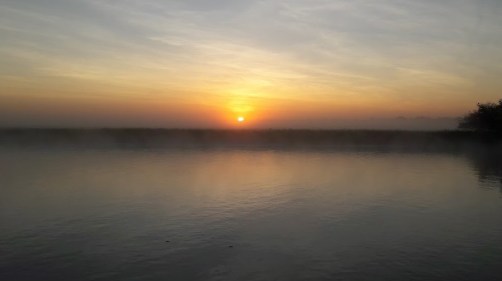 The enthusiastic guide told us how the Buffalo grass rises with the water level of the three Alligator Rivers which was low due to The Dry. Large expanses of grazeable land disappear during the wet, allowing the salties to spread out, only to be forced back to their more confined territories in May-June. With his help, we saw: Magpie Geese; Egrets; Night Herons; Cormorants; Willy Wagtails; Crested Pigmy somethings; Whistler Kites; Sacred Kingfishers; Sea Eagles; Red Tailed Black Cockatoos; Sulphur-Crested Cockatoos; Golden Tree Snake and multiple salties.
The salties held a fascination for most on the boat. We learned that Estuarine Crocodiles are the most aggressive crocs in the world. Males grow up to 7 metres long, females 3 metres.  We were introduced to “Harry” whose territory we passed through. He was a 5 metre bundle of fun.
The water temperature is around 27 degrees causing the salties to cool below the preferred 34. Having been immersed all night feeding, they climb up the banks as soon as the sun rises, recharging their batteries with menace.
Having made running repairs to Louise’s panniers at Cooinda, we headed right up to the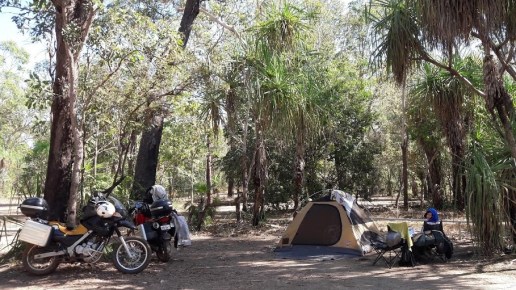 north east corner of the park, past Jabiru (where we posted Sam’s birthday card), in time to pop the tent up at the enjoyably bush Merl camp site before riding the short distance to Ubirr. Here we joined a two hour guided walk up through the craggy rocks that served as a gallery for ancient rock art.
The education was much appreciated. What processes informed the age of the art, the stories behind each drawing and how the Aboriginal occupation of the land changed over the millennia with climate change.
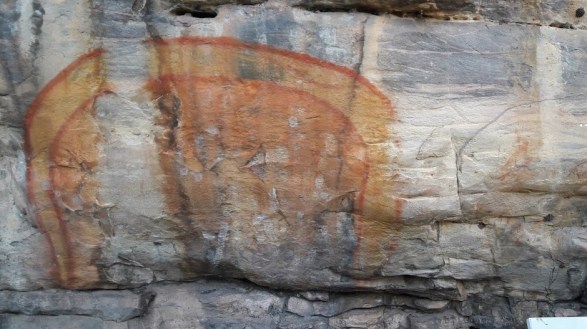
The Rainbow Serpent drawing above has the explanatory sign below which delivers an unambiguous message: “Keep Your Children Happy and Safe”.
 .
.
The ranger dismissed his class by sending them clambering up Ubirr’s highest rock in time to gaze all around to Arnhem Land (a large Aboriginal Reserve) to the north and east, north west to the Van Diemen Gulf into which flow the West, South and East Alligator Rivers, then west to distant hills beyond which was Darwin.
There were up to 50 or 60 people on top of Ubirr and all fell silent as the sun slowly sank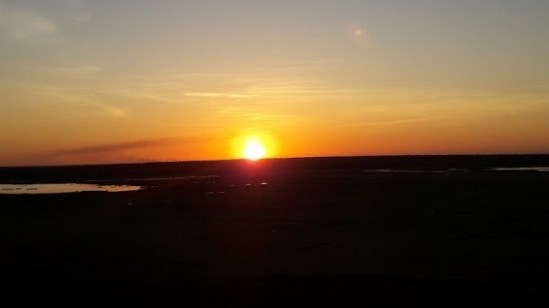 to and below the horizon. There was something spiritual about this place, it put me in mind of Cape Reinga at the northernmost tip of New Zealand where the Tasman Sea and Pacific Ocean enjoy and enthusiastic meeting.
Our time in Kakadu concluded the next day with an early up, brief breakie, tent down, gear stowed and a 70 km ride down to Burrungkuy at Nourlangie for one further Ranger talk from 9 am to 11 am. Again, excellent educational content covering ancient sites, tools, occupation and more rock art. 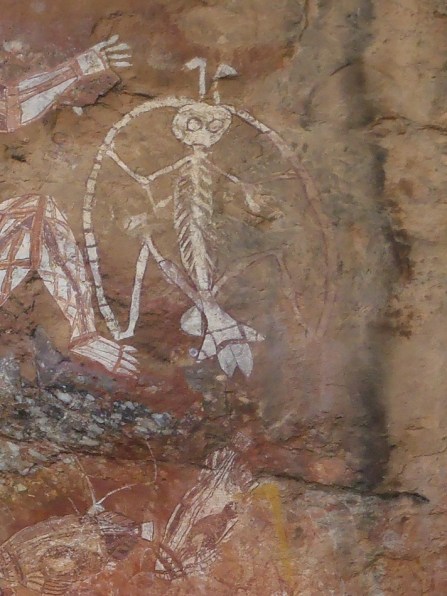 Another Dreamtime story, another Spirit Ancestor example, Namarrgon (pronounced narm-arr-gon) is the Lightning Man, an important creation ancestor responsible for the violent lightning storms Kakadu experiences every wet season. We saw drawings of him (left) at the Anbangbang Gallery (think: rock-face-in-a-cave) at Burrunguy (Nourlangie Rock). He uses his stone axes to split the dark clouds and make lightning and thunder. Namarrgon’s story began on the coastline of the Coburg Peninsula and ends in a rock shelter in the sandstone country of the Arnhem Land Plateau – where he remains today. During his travels he left his power behind at many places. On his last journey he approached the escarpment from the east, looked over the sheer wall, then took out an eye and placed it high on the cliff at Namarrgondjahdjam (Lightning Dreaming). Here it sits, waiting for the storm season. This is a sacred and dangerous place that must not be disturbed or catastrophic events will follow. During the build up season you can see Narmarrgon’s children, aljurr (Leichardt’s grasshopper) on the fragrant pityrodia bushes which is the only plant they eat. Then, as every Wet Season begins, Namarrgon, the Lightning Man, asserts himself as great black storm clouds approach from the north, complete with blazing lightning strikes down from the angry skies.
These Kakadu insights into the Aboriginal relationship with the land, their family rules and structures were fascinating. Most of all was the use of drawings of the Spirit Ancestors to help record stories and hand down their belief system.
Finally, we rode out of Kakadu through the afternoon heat to Kathryn where we plopped gratefully into the pool at Notts Crossing Tourist Park.
 jrtonlocation.com