

Above you may be able to read the mileage on my speedo on the morning we left Darwin – it says 31,791 kms.
From Darwin we travelled nearly 500kms to a bush camp just short of Victoria River Road House. Our two nearest neighbours were gold diggers en route to different destinations where each harboured hopes for The Big Nugget.
Early up on 7 September and we crossed into Western Australia, a land mass approximately seven times the size of France. 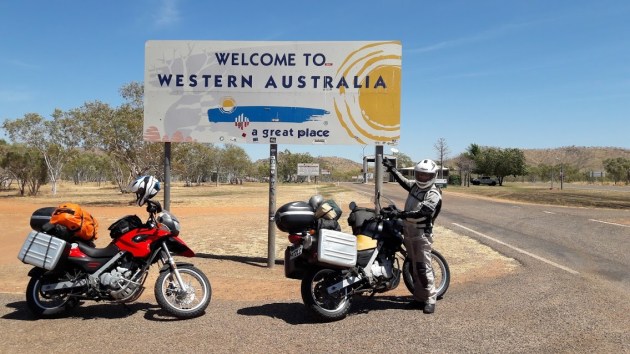
Not far beyond lay Kununurra, our destination for one night. Someone had described it to us as an attractive little town but we were left pondering what sort of crumby conurbation they had for a benchmark. We sampled supermarket, liquor store, café and motel – yes, a night off from the tent – and have no complaints. Perhaps the town’s value lay not in the quality of its buildings but in its location as the gateway to the Kimberley.
El Questro
On 8 September we rode happily out to enjoy a 3 night stay at El Questro.
By prior arrangement, our panniers, top-boxes and strapped-on luggage was 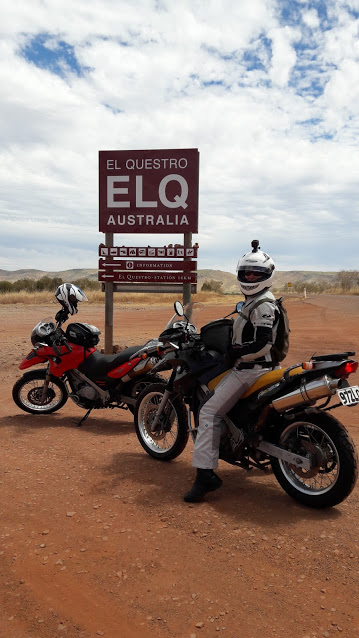 collected from the Kununurra Information centre, thereby allowing us to ride unencumbered the 103 kms to El Questro, not far down the east end of the notorious Gibb River Road. The road was sealed all the way to the turn off into El Questro but we wanted to be much less top heavy and nimble as we tackled the 16 kms of unsealed road in, which included a couple of river crossings. You may recall that we struggled with, and Louise had a couple of spills on, the unsealed road to Gumlon Falls, causing us to abort the visit. Thus it was with a modicum of intrepidation we entered this enormous station, renown globally for its wilderness status and wealth of natural assets.
The road was great, not rutted or corrugated and we found 50 kms per hour a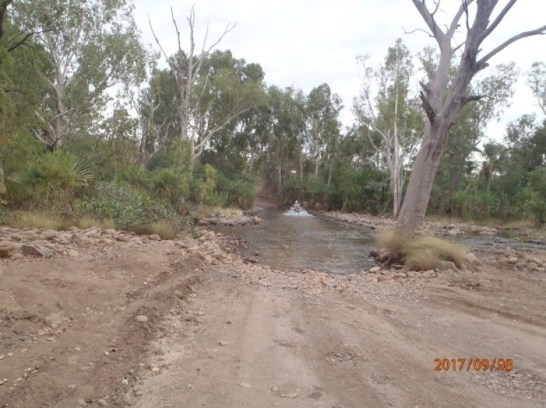 comfortably cautious speed. Until we got to the first river crossing. I walked it to gauge “bottom and depth” and then had a go in first gear. The water was about 0.3 metres deep but with the back wheel driving, the bike carved its way across with my legs dangling like a tight-rope walker’s arms. I got quite a buzz from it. Louise had a go but too cautiously, which invited problems, such as the temptation to stop and think about it ………. so we both walked her bike across. Just before reaching the El Questro station and camp site, we had to cross the Pentecost River. This crossing was a bit longer and at one end, a fraction deeper. This time I crossed grinning and whooping like an ape – marvellous fun. Louise wasn’t tempted so I took her bike across as well. But her time was approaching fast.
Having struck camp (below),  we contemplated which of the various thermal pools, gorges and other natural attractions we would tangle with. Virtually all of them required us to go back out along part of the same entrance road, significantly, the part that lay beyond both water crossings. Louise needed no second invitation and across she went without even a wobble. There’s no photo as, by prior agreement, I was standing in the water ready to help!
On Saturday we set off to walk and climb the El Questro Gorge,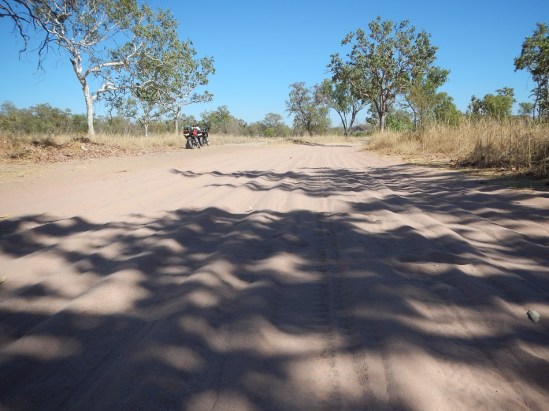 both tackling the two water crossings along the way. However, the track off the main drive that led to the Gorge soon became soft sand and both of us struggled with this – see photo on left. We knew that weight as far back as possible (off the front wheel) and a bit of speed was required but neither of us were up to this with unfaded memories of the Gumlon Fall track rushing back, particularly for Louise. We left the bikes at the side of the track (photo above) and walked the couple of kms to the beginning of the walk proper.
This walk was described as 5 on a scale of 1 to 5, 1 being the easiest. Initially it was a track to be followed over stones under a palm tree canopy but as we progressed, the sides of the gorge grew higher and drew closer. The halfway point is defined as the 1st decent pool with access beyond being an energetic and nimble climb up through a 3-metre-high crevice, starting from a depth of about 1.5 metres below water level! No worries.
The next challenge was a boulder stairway – same result. On to the last biggee which was a climb up the side of a 5-meter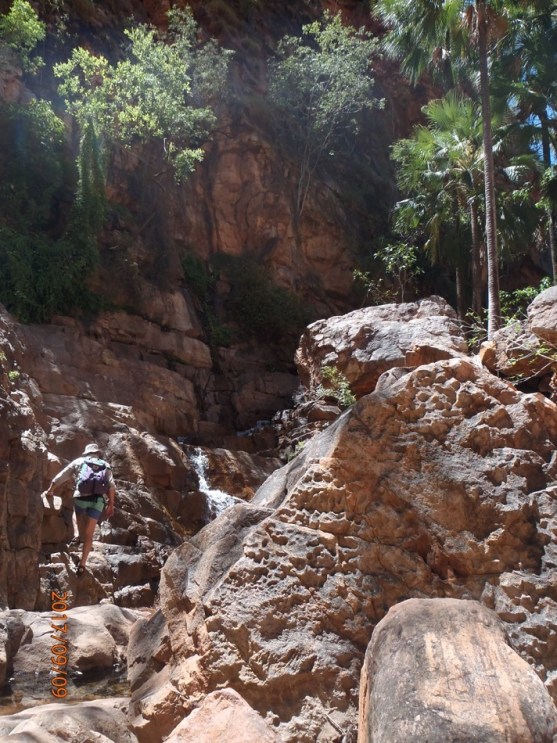 waterfall.
We were struck by the differing approaches age brings. We were all caution, thinking of the implications of a slip and fall, plus the more difficult descent with legs leading the way. But 25-year-olds, as we once were, nipped up with barely a backward or downward glance.
The reward for all this excursion was not far beyond. The entrance to the final chasm and waterfall-fed pool, had a smaller pool as its vestibule with a frond lined jumping-in rock. Per the photos below, ladies second in this case!


This was enough reward in itself – we both savoured the cool, clear water after the sweaty climbing – Louise shown below. 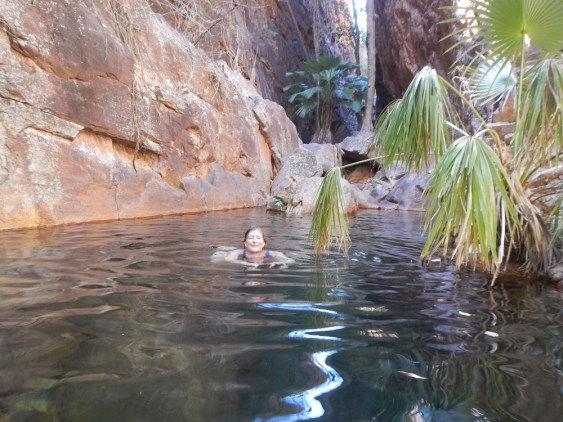 But then we clambered a little further to a longer, deeper pool with a visible rock at the far end where the waterfall landed…………. doubling as a diving platform. All was shade due to the 100+ metre high gorge walls barely 4 metres apart.
The walk was 9 kms long and left us feeling contentedly buggered and beer-worthy.
The Sunday deserved a more leisurely style so we tackled the first two thirds (3.2 kms round trip) of the Champagne Springs walk, far enough the inspect a 1,000 year old Boab Tree. What a different world existed when it was a seedling.


.
This tree was massive in girth, about 17 to 18 metres in circumference but not so much so in height. Above left, Louise poses to indicate relative size. It was quite irregular in shape, being bulbous overall but with odd-looking protrusions, the one above right being like a mouth but hopefully not like one that Sam encounters professionally.
I really don’t like snakes but this does not explain why there are no photos of any here. We simply haven’t seen any, despite others here doing so exactly where we have been or were going.
El Questro was a veritable oasis teeming with bird life, with many of the usual suspects singing to us in the early morning – 5 am when we were in that part of WA.
We have been impressed by the various Aussie camping set-ups. The photo below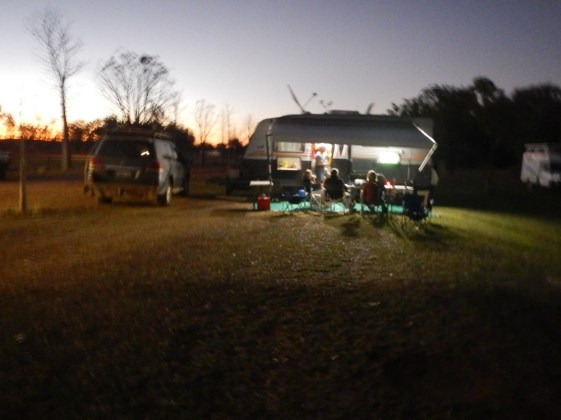
shows a rugged caravan that is capable of river crossings and in shot, acting as restaurant and TV room in one. Many had satellite TV allowing the owners to keep up with the footie, the TV screen being the bright rectangle towards the right.
On Sunday, our last night, we shunned the camp kitchen and our own catering skills, instead treating ourselves to a meal in the restaurant. Fortunately, the dress code was ‘bush’.
Anyone heading into this part of Australia should visit this place: www.elquestro.com.au
Lake Argyle
From El Questro we back-tracked past Kununurra to Lake Argyle for one night. The camp site was high on a bluff looking SW over the lake that bore similarities with the Marlborough Sounds. But better still, it offered an infinity pool to capture the mood.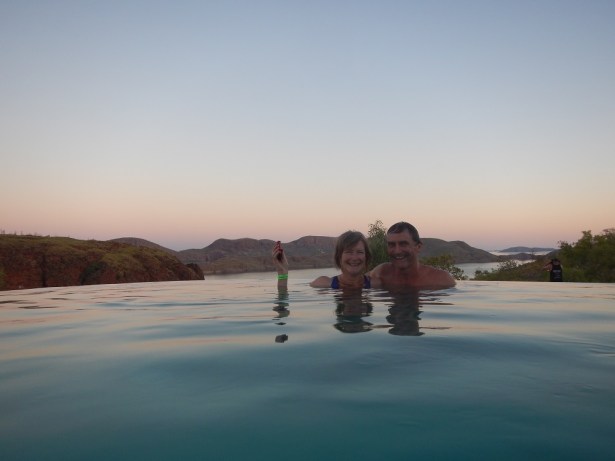
In the 1970s the lake was formed by a A$300 mil dam that has been upgraded over time with hydro-power generation and other complimentary structures in the region to


facilitate irrigation to over 10,000 hectares of horticultural land that would otherwise by bone dry for more than half the year.
The Bungle Bungles
On 12 September we left Lake Argyle early and returned to Kununurra, topped up our supplies and ventured on to and down the Great Northern Highway to Turkey Creek Roadhouse.
The next morning we rode 50 kms down to Mabel Downs Station Caravan Park for our guided tour of the Bungle Bungles, a natural ‘outcrop’ of extraordinary-looking rocks that were only revealed to the world in the 1980s. In 1987 they inspired the formation of the Purnululu National Park and have been accredited with World Heritage Site status.
Our driver and guide was no less that “Bushy” in the photo below .
.
You may have encountered the hardy breed before. Initially I suspected Bushy eats gravel with sump oil for breakfast. He whirled the 4×4 30 seater ‘go anywhere’ bus along the track and after 1.5 hours turfed us all out at the southern end of the Bungle Bungles to walk a couple of kms to Piccininni Creek Lookout. The walk took us over the dry creek bed that reminded me of the South Island’s braided rivers – except that this creeks river bed was solid sandstone as shown in the right hand photo.


The Piccininni Look-out revealed a classic Bungle Bungle landscape – as shown below.
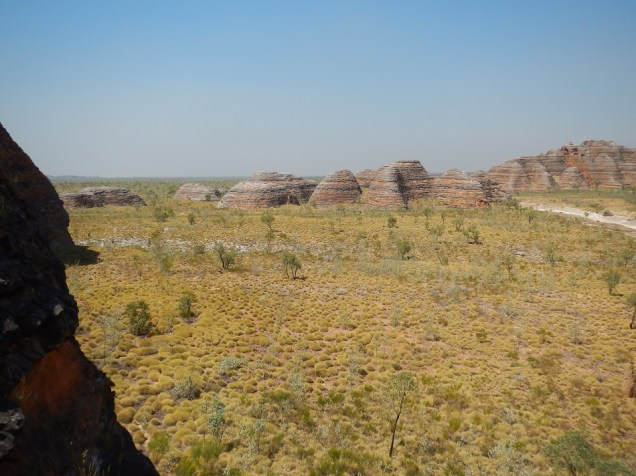 From there we walked to Cathedral Gorge, past or rather through a clearly visible
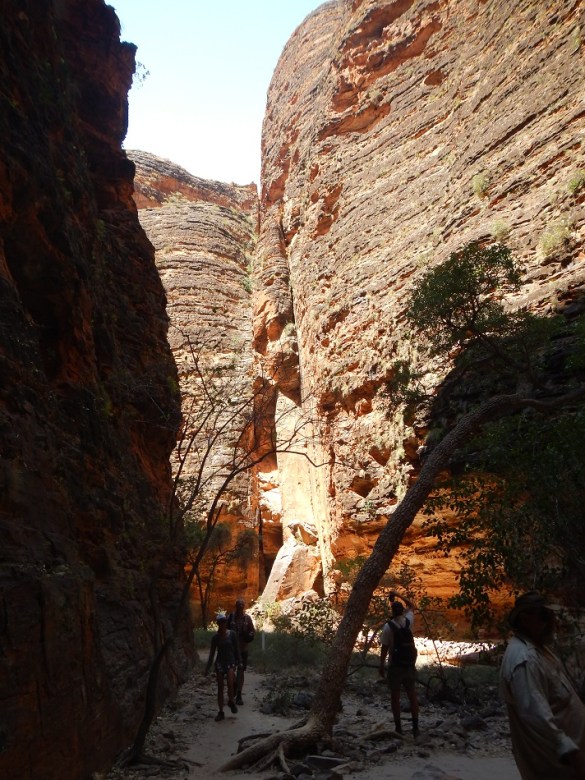 fault line that moved 70 metres in one hit when it last bothered. A close look at the photo will show a clear vertical ‘cut’ which is mirrored diagonally across the gorge.
And on to the “Cathedral” itself. The photo below,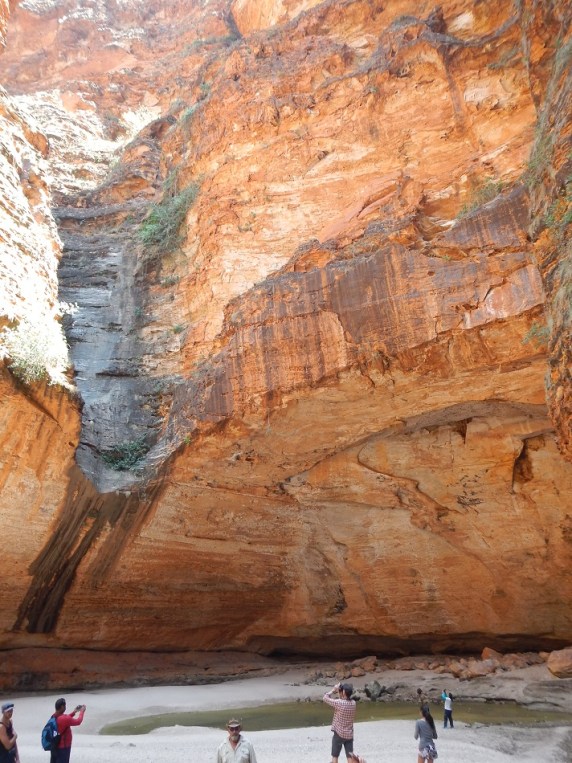 like most, cannot do this place justice. What a venue for an opera – in the dry season. You can make out where the water drops in – it’s the black tongue to the left of picture
By the time we wandered back to the bus, we had walked 5 kms and Bushy had laid out a simple but healthy lunch. His own take on a ham & salad wrap was to take a couple of slices of ham instead of the wrap, then fill it with more ham. The green stuff didn’t tempt him.
From there we motored 30 minutes to the north end of the Bungle Bungle range where we were encouraged to walk into the Echidna Chasm.
This walk took us out of the 40-degree heat into Echidna Chasm where the walls were over 100 metres high and for most of it, were barely 2 metres apart.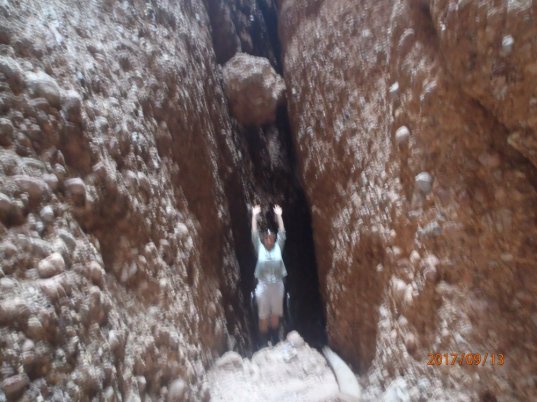 The temperature was refreshingly cooler. Bushy then whizzed us back to camp by 4.30 allowing Louise and I to forgo the BBQ and ride the 50 kms back up to Turkey Creek before dusk which arrived around 5.15. This had us on full alert as we were approaching sundown when the roos like to bound across the road and wild cattle wander onto it and glare at oncoming traffic. An example of this hazard is shown below.
It was a great excursion with such a unique set of landscapes. As we farewelled Bushy I was inclined to modify my earlier view of him, concluding that his morning meal of gravel and sump oil may just have a teaspoon of honey in it.
The following morning we set off south and then west along the Great Northern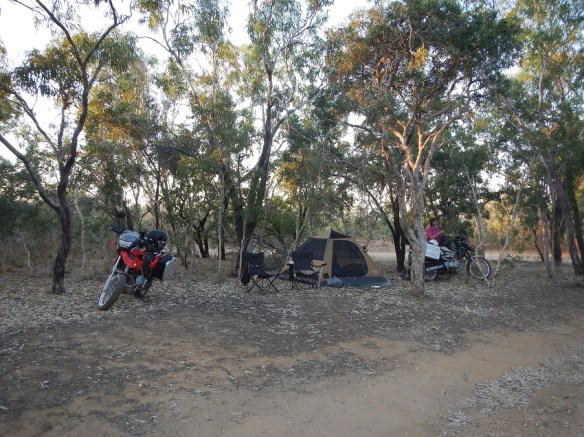 Highway, enjoying an overnight bush camp 100 kms beyond Fitzroy Crossing which some people we met at Lake Argyle tipped us off to. Finally, on 15 September, we rode the remaining 290 kms to Broome, leaving the Kimberleys behind us.
The Journey to the End of The Top End
Our particular corner of the Roebuck Bay camp site in Broome was a bit tatty but the beach was beautiful and the salties absent. We had bumped into a couple of fellow bikies in the Information centre. Lance and Dave were both from Oregon, USA and had rented a Suzuki V-Strom each from Brisbane and were doing an anti-clockwise ‘lap’ of Aussie, but in a much shorter time than ourselves.
My observations of Broome are modest as most of the day we spent there was in the library, accessing the free wi-fi and trying to make progress with this web site. The little we did see was of a newish town selling pearls and catering to the standard cruise ship bunch, the over fed, newlywed and nearly dead brigade, waddling around like rotund pink beacons seeking something to amuse them on their daily ration of shore time. I asked Louise to shoot me if ever I showed an interest in a cruise.
On 17 September we left Broome and rode …………
……. Into The Pilbara
stopping at Sandfire Roadhouse where we met Kiwi Rob. That afternoon, the Americans and 3 Kiwis all camped at the beach site across from Sandfire Roadhouse.
The next day we all headed into Port Hedland for provisions and to look at the ships loading iron ore. The public viewing point gave only a glimpse of the loading bays.


I was told that when loaded, there was 20 metres of boat below the plimsole line. The one above right is being ushered out to sea by some eager tugs, with not a lot showing above the waterline. All are bound for China, where the bulk of the Pilbara’s iron ore is sent. Where some of it comes from is covered a below under “Tom Price”.
Without staying at Port Hedland, we rode south to Karijini National Park, Dales Gorge camp site in particular. 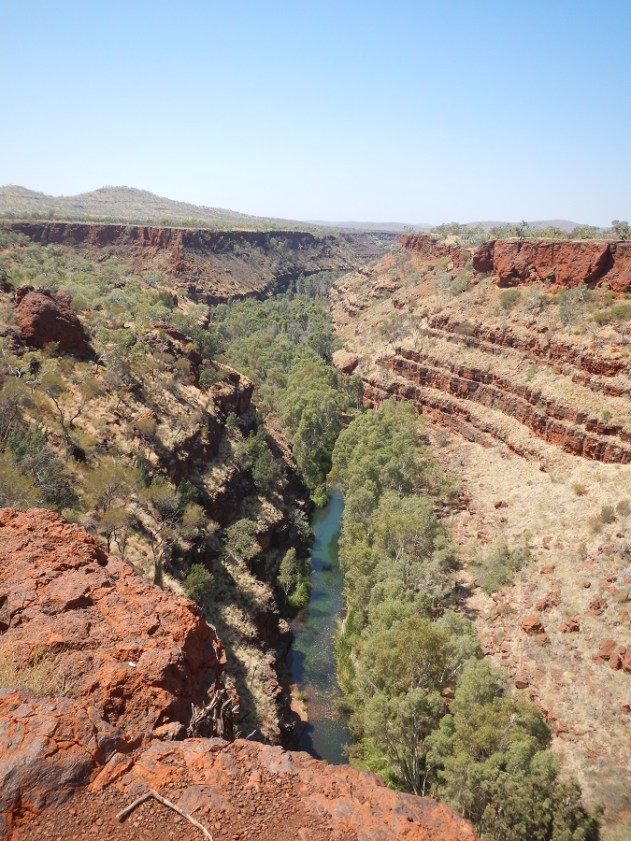 Travellers we had met had raved about this place but for us, the reality was disappointing. The camp site was barren, virtually devoid of shade trees, important in the upper 30s. The ground was hard and red with tent pegs standing no chance. Rob headed off on his Moto Guzzi after just one night.
Dales Gorge itself (photo above) was refreshingly verdant.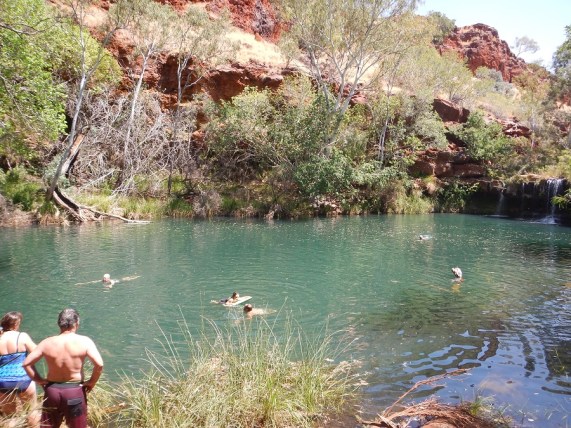 We did the full 2 hour walk ending at Fern Pool – shown above.
The two remaining pairs of intrepid motorcyclists all departed Dales Gorge and Karijini National Park on the 20th September, going different distances that day. Rob about to depart one day (left), Lance and Dave the next (right).


Tom Price
We rode the107 kms to Tom Price, a mining town built by Rio Tinto specifically for the workers at its Tom Price iron ore mine.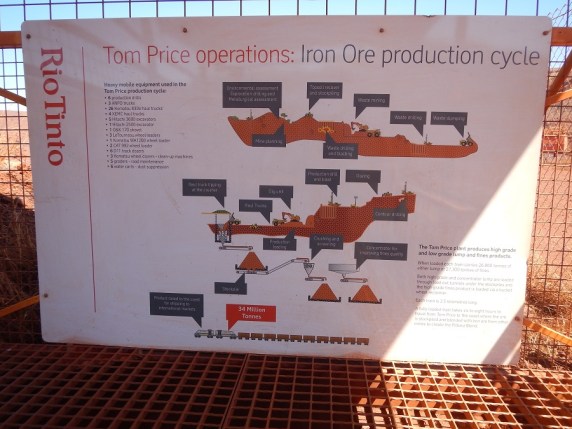 On arrival at the Information Centre, I snapped up the chance to go on a tour of the mine leaving 30 minutes later.
On the right is an overview of the operations of the Tom Price mine.
Left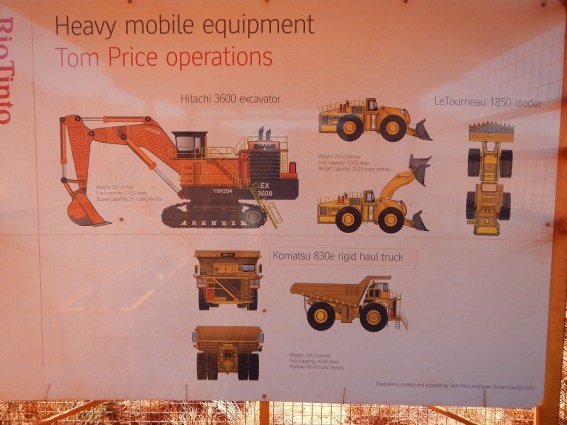 is some of the gear. The Komatsu 830e was the larger of the dump trucks in use. The rear of one and front of another are shown lurking in the garage, more like a hangar, see photo below.
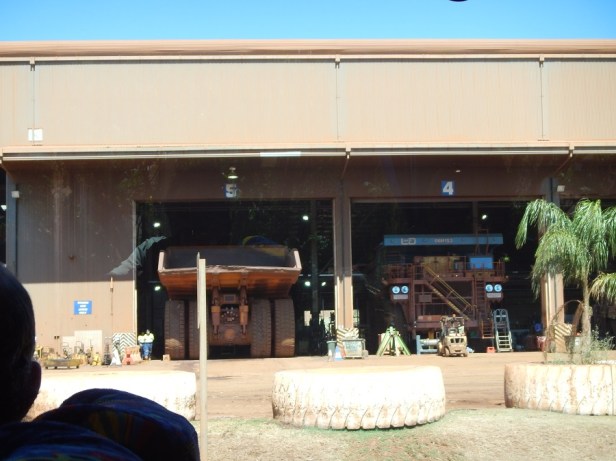 The figures that poured from our guide’s mouth were mind-boggling. The Komatsu trucks cost A$4.5 million apiece with each tyre a cool A$40,000.
The actual open cast mine pit below was once a small mountain but now only the shoulders at each end are visible and in between them an oblong hole that is deeper than the mountain was high.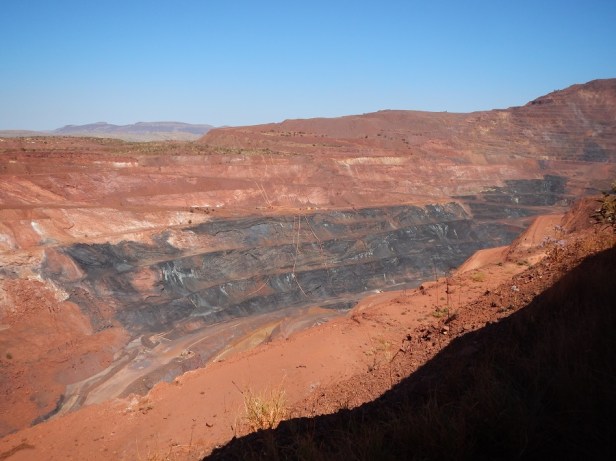
This single mine produces around 28 million tonnes of iron ore per year and in 6 years will be exhausted. Rio Tinto has 15 other mines in the Pilbara, collectively producing 318 million tonnes of iron ore in 2015. One is 16 kms from Tom Price. So they built a conveyor belt to transport its production to the Tom Price processing site. The cost: A$15 million per kilometre.
Each train that takes the ore about 400 kms to Port Hedland is itself 2.6 kms long. The drivers are paid A$240,000 a year but will soon be relegated to the scrap heap due to automation arriving with the “Fat Controller” residing in Perth.
The Hammersley Range in the Pilbara is about 600 kms long and made mostly of iron ore of one grade or another.
The scale of the Pilbara and its iron ore operations, like Australia itself, is massive. The map below was displayed on the Nanutarra Roadhouse wall, showing the length of our journey from Tom Price to Exmouth.
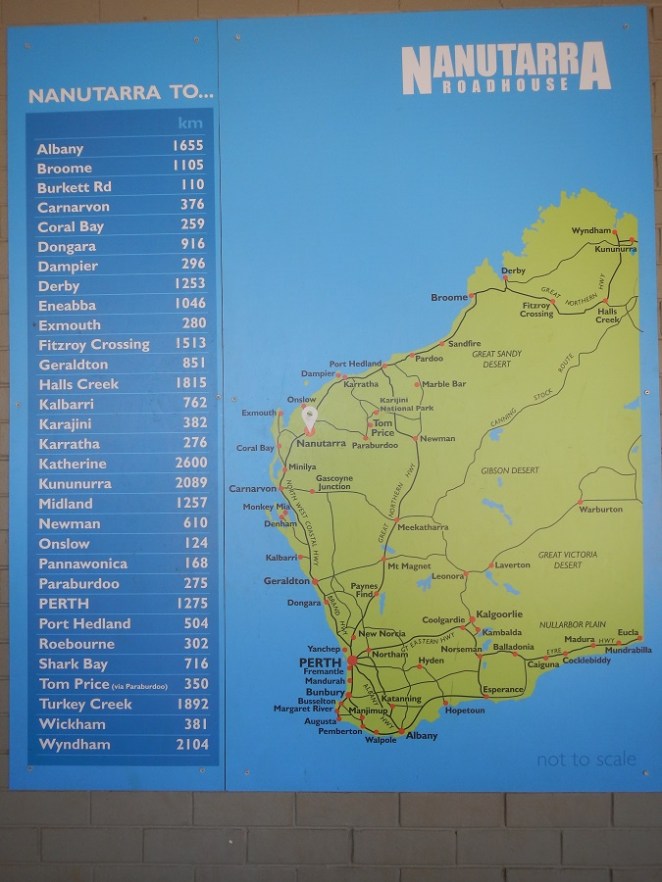
But it was dry in there so the last day’s ride west, on 21 September, took us 630 kms to Exmouth and the Indian Ocean Coast of Western Australia. This marked the end of our journey across Aussie’s Top End with the trip south to Perth and beyond about to start.
 jrtonlocation.com
Thoroughly enjoyed reading this Jeremy. Very informative and beautiful countryside. Where this chapter ends is almost as far up as I have been in Western Australia.
LikeLike