
Louise would have remained faithful to the two-wheeled mode of transport but we had sampled plenty of days of long, straight roads across endless flat expanses of nothingness and four more across the Nullarbor was four too many for me. Additionally, I had fancied the idea of a long train trip for some time.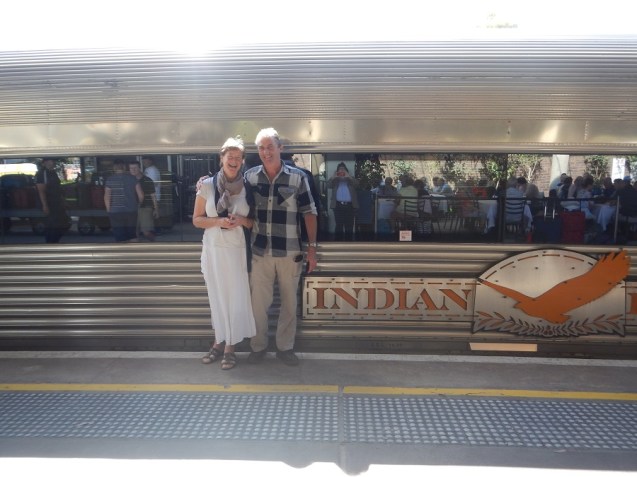
Thus it was that our bikes were  consigned to lorry transport on 17th and we boarded the 675 metre long Indian Pacific Train at East Perth station for an all-inclusive choo choo ride across to Adelaide, some 2,669 kms to the east.
Unlike a long-distance trip on a passenger jet, there is scenery passing the window.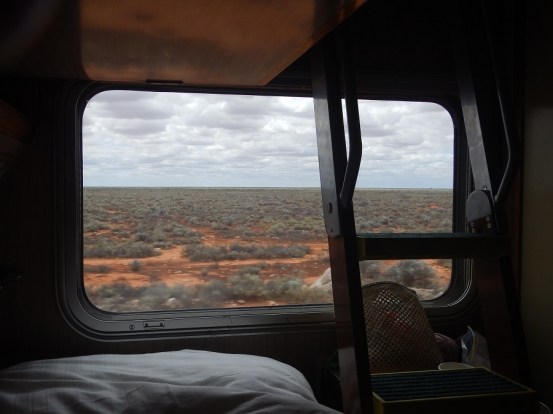
However, after the first couple of hours of valleys, hills and river views, we crossed a long stretch of the wheat belt with the land flattening out and eventually, becoming desolate in a familiar way.
We stopped at Kalgoorlie for an off-train excursion.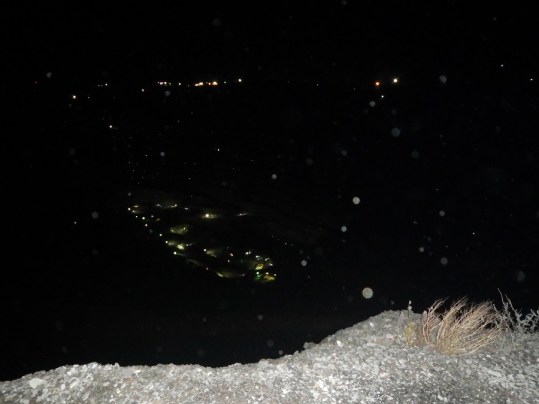 Due to a wild storm the previous day, most of the town was in darkness and our trip was confined to a look into the “Superpit”, the largest open cast mine in Australia – also in darkness. The patterns of little lights are the large lorries filling and making their way up and out of the 3.5 kms long, 1.5 wide and 600 metres deep pit. Like the Tom Price mine up in the Pilbara, the numbers were mind-blowing. It took the entire 255 tonnes of dirt in the back of one house-sized lorry, to make a golf-ball-sized lump of gold. The cost of production is high at around US$900 per tonne but with the spot price being relatively stable around US$1200 and the scale of production so vast, there’s a bit of profit being enjoyed.
Early, too early for us, on the second day, the train stopped at Rawlinna where there seemed to be little to suggest there was a place to be named. Apparently, Australia’s largest sheep station abuts the track – a 2.5 million acre farm, 300 blades of grass and 70,000 sheep. Lurking in the dim recesses of my brain is a lecture or two and a BSc (Agriculture) that mumbles something about the maths not adding up too well – for the sheep.
The next stop was at a thriving metropolis named Cook. Both inhabitants exist there to service the train. Initially I thought that, 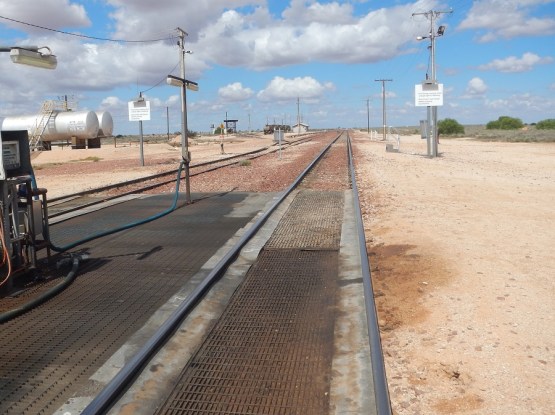 with just one train passing through per week, life in Cook might be a fraction dull. But when I asked a chap driving a ute about the pace of life, or something along those lines, he explained how Cook receives visits from other trains, all bringing supplies for the Indian Pacific. Fuel was one example he volunteered. In case you think the railway line shown above looks straight, it was. In fact, 487 kilometres of dead straight rail track – the longest straight stretch of railway in the world.
At pre-dinner drinks on the second night, we were advised to put our time-pieces forward 2.5 hours due to crossing the border into South Australia during the night. With an early morning arrival in Adelaide the next day, this slight of hand was to crimp our night’s sleep and its announcement, intended to cramp our night’s frivolities in the bar. Eventually, we rumbled into Adelaide, farewelled the wonderful staff that had looked after us and the new friends we had made on the journey. This choo choo treat wetted the appetite for other long rail journeys elsewhere in the world.
Adelaide
On 24 November, after three nights in a central apartment, we moved into a house in Glenelg where we were entrusted with the care and maintenance of a thoroughly independent cat.
A few days later Holly and Hamish arrived and stayed at a nearby motel for 4 days. This marked the end of their 2+ years in Sydney and the beginning of their own major overseas trip. 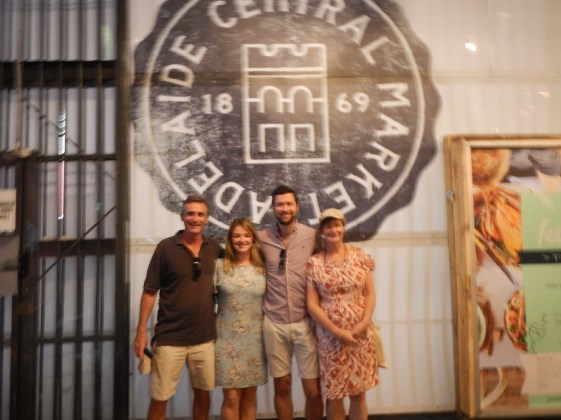
Photo left, we enjoyed introducing them to the Central markets.
Hamish’s birthday fell right in the middle of their stay. We booked a table at a tapas place
and while the girls were getting fluffed up, I took Hamish on an advance sortie to The Wheatsheaf on George Street, to sample its hand-pulled offerings. A Ferrari garage interrupted our tram trip, but Hamish didn’t seem to mind.
Complete with the girls in the team and replete with good ale, we had a delightful meal, after  which, Birthday Boy wished to kick on and find a whisky bar or two. Louise and Holly headed home while I accompanied Hamish as he sniffed out hidden dungeons a little bit like Baxter’s in Sydney. The photo above right was taken in an attempt to record the beautiful manifestations from the top shelf , and as if to back up the claim that the camera never lies, the shot is slightly blurred. After three bars and three delicious shots, I felt it was time to totter home. A great night and a birthday well celebrated.
Friday came and Holly and Hamish departed to Cairns, Holly via a family do in Canberra, Hamish to complete a work project. On Tuesday 12 December, they flew out of Cairns to SE Asia and the beginning of their ‘Big OE’ – which is their story.
Old school friend Andrew Renaut arrived the following day to celebrate his birthday of the previous day and then join us at the Adelaide Oval for a couple of days of the second Ashes Test. The venue was great giving us excellent views of the action (below left).


The old scoreboard (above right) was magnificent, although it gradually became less so from an English perspective. The Adelaide Test was a day-night experiment, allowing locals to  get a day’s work in and still see half the action. For us the delayed start facilitated a visit to the Central Markets for a forage and a lunch – right. On his last day we hired a car to visit a few McLaren Vale wineries, starting at D’Arenberg, going out to Yangarra (superb) see photo below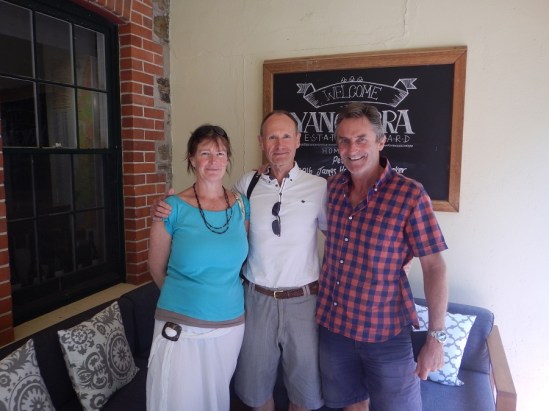
and finishing at Wirra Wirra (not so good). From there to The Star of Greece for a splendid lunch – any foodies visiting this area should work a lunch here into their itinerary.
Before leaving Adelaide we were due to meet up with friends Polly and Ray but a tummy upset ruled Louise out and cramped my options when I caught up with them for an abbreviated lunch – it was good to at least catch up on each-other’s news.
On Sunday 10th December we loaded our neglected motorbikes and rode 380 kms south east to Penola in the deep south east of South Australia, close to the state border with Victoria.
Penola Flower Farm – A ‘Workaway’ Stay
About 35 kms along the road from Penola to Robe on the coast, is a 200 hectare farm, part of which is planted with various varieties of native Banksias – see example below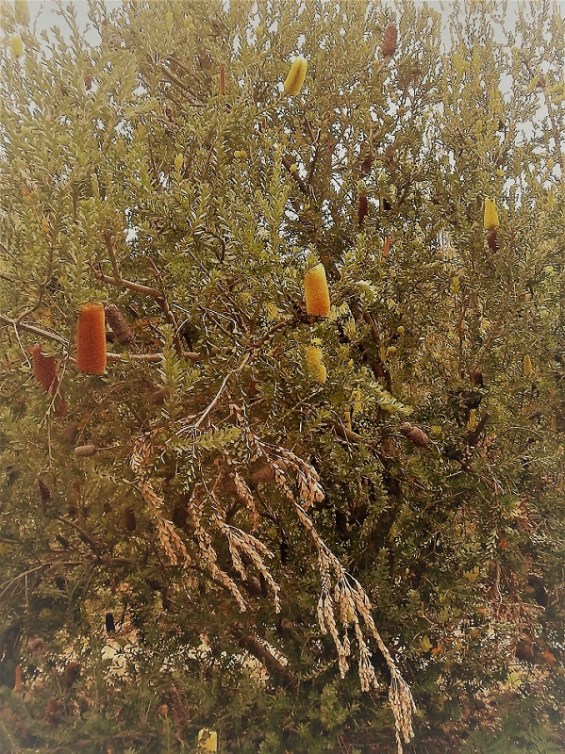
We met the owners, Jessie and Edna in the Penola Bakery and followed them away from signal, away from people and along to their remote farm. They showed us around, providing an insight into this unusual enterprise and then left us at the one-bedroomed cottage which lies totally surrounded by old native bush, about 1 km from their ‘farm’ house (they also have a cottage in Penola with eventual retirement in mind).
Jessie and Edna’s interpretation of the “labour-for-board-and-lodging” exchange struck us as generous – we were required to work for 6 hours on 3 out of 7 days – they provided us with a spacious cottage and funded our groceries.
Our main project was to restore a fenced plot, including the fence itself, with the objective 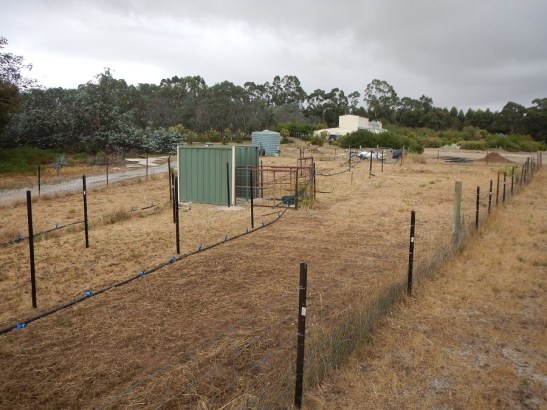 being to create a predator-proof area in which to experiment with different annual crops, with a small chicken population being rotated to improve soil aeration and nutritional quality.
When it became too hot, we all shifted into the main flower shed to prepare that day’s crop for market. Apart from benefitting from the shade, we learned about Banksias, the flowers, the buds and the nuts, as saleable items. The main market, via a wholesaler, is Japan where other producers in Africa and elsewhere are less able to compete. The idea behind the experiment  into annual crops is to identify a viable diversification to the farm’s main income stream while keeping the manual effort to within the two-person team that is already pushed pretty hard. The photo on the left shows the progress we made relative to the one above it, taken early on in the effort. We enjoyed the work, the learning opportunity and most of all, the insight into this particularly brave and hard-working couple. Thinking of Africa,
  while I was banging in fence posts, Louise spent many hours wrestling a lawnmower over the dry, uneven ground, taking on Kenyan hues as she went – see photo on right of my Kenyan wife.
Meanwhile, back at our cottage, there was wildlife a-plenty, not all of it outside.
Having climbed into bed one night and about to read, 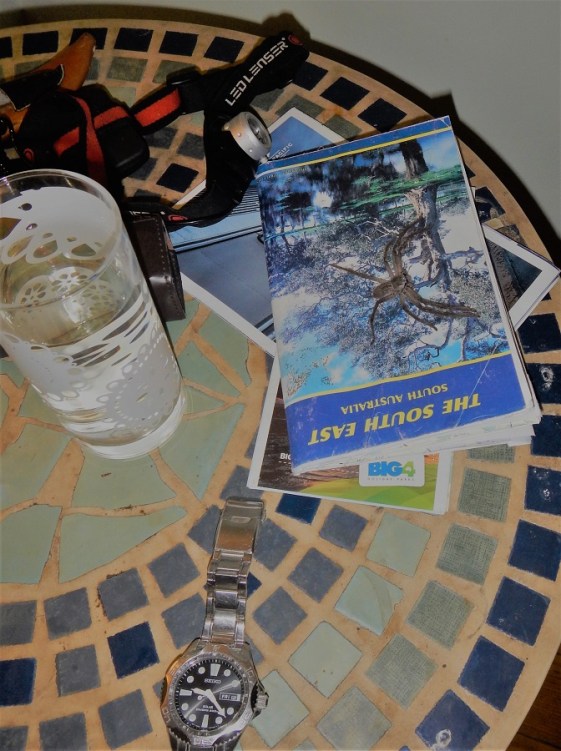 I noticed a large Huntsman spider skulking on the map next to me on the bedside table. He didn’t seem to mind being relocated outside as much as I minded him remaining inside.
On the deck outside the broad glass frontage of the cottage was a stainless steel water bowl. The arid nature of the area made this water bowl a powerful magnet for birds which swarmed to the deck to drink and bath, providing us with far better entertainment than any TV could, even one with a signal.


The Crimson Rosellas above were as bountiful as they were beautiful but the list of birds we identified species is: Crimson Rosellas; Little Wattlebird; Silvereye; White-browed Scrub Wren; Superb Fairy Wren; White Fantail; New Holland Honey-eater; Rufous Whistler; Brown Treecreeper; Peaceful Dove; Eastern Yellow Robin; Red-browed Finch; White-eared Honey-eater; White-naped Honey-eater; Yellow-faced Honey-eater; Grey Carawong; White-throated Treecreeper; Horfield’s Bronze Cuckoo; Brown Thornbill; Common Bronzewing.
Coonawarra Wine Region
Penola is right on the southern edge of the Coonawarra wine region, a persuasive proximity.
On Saturday 16th our visits were: Bellweather Wines; Redman Wines; Wynns – see photo of iconic main building below 
Zema; and lastly, Balnaves. Of these, our pick was Zema, the quality of its Shiraz and Cabernet 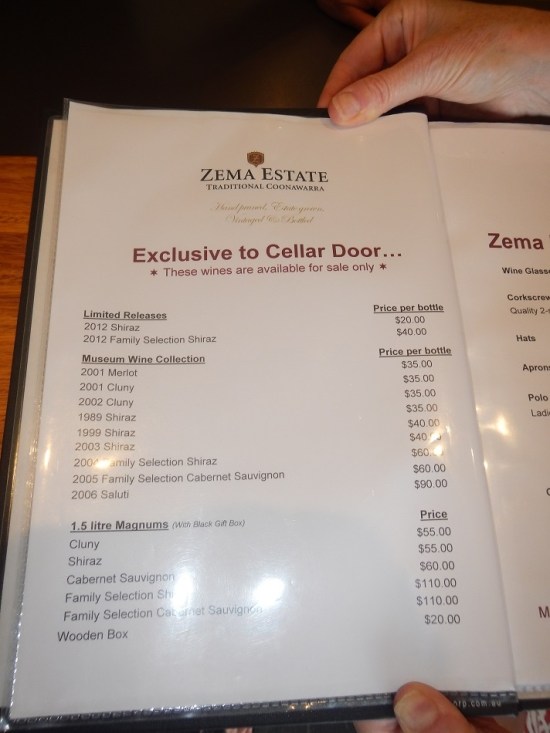 Sauvignon was grander than the price suggested.
Being gluttons for punishment, we returned the next day:
Rymill; Bowan; and lastly, Leconfield. Louise particularly rated Bowen and although wowed by its wines, my pick from the whole lot was still Zema which also had the good grace to offer a ‘Museum Wine list, as above right.
We found the Coonawarra Shiraz quite striking. There was an almost  sweet backdrop to the flavours arrayed on the pallet. The answer lay beneath our feet in the famous Terra Rossa soils – per the photo of a soil profile to the left.
Quoting the region’s promotional material:
Almost a million years ago, an ocean teeming with sea-life lapped at the feet of the ancient Kanawinka Escarpment. Then came an ice age, and the great melt that followed led to the creation of the chalky white bedrock which is the foundation of this unique region. But nature had not finished, for with her winds, rain and sand she blanketed the plain with a soil rich in iron, silica and nutrients, to become one of the most renowned terroir soils in the world.
Most of the  wineries we visited or passed had prominent Santas, each demonstrating a particular recreational activity. This ‘theme’ seemed to have been agreed as a local promotion. Louise included a few in her Christmas post. The one above right was outside a farm on the road from Penola back to the flower farm. This one is fishing.
All too soon, 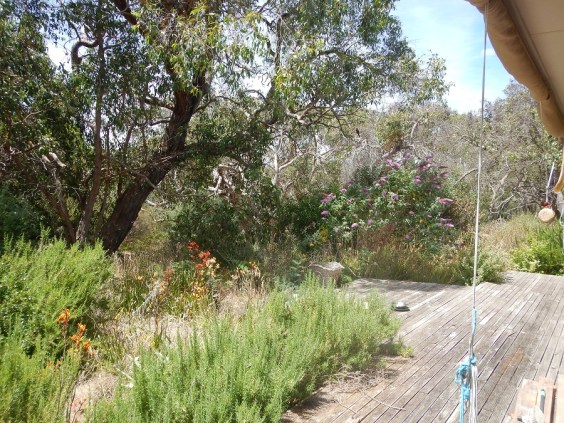 our time with Jessie and Edna came to an end and on Christmas Day, we took one last glance at the aviary-like theatre and rode off east 340 kms to check into the Mid City Hotel in Ballarat before 12 noon when a ‘Special Christmas Day’ lunch awaited us.
Bye-bye South Australia – Hello Victoria
Early on our journey to Ballarat we crossed the border into Victoria and having been asleep on a train when we crossed from WA into South Australia, I’ve included both border crossing signs below, to be sure that you understand where we’ve been.


Our next destination was really Cockatoo in the Dandenong Hills east of Melbourne where we were due at a ‘house/dog sit’ on 26th. We didn’t want to spend too much of our Christmas Day on the bikes, hence the overnight stay in Ballarat. And what a treat it was too. The Mid City Hotel is a little tired in terms of décor but the management and catering staff pushed the boat out with their Christmas Lunch Special with a fixed, all inclusive price. The food was exquisite and the wines selected to compliment it were interesting, appropriate and in most cases, sumptuous. A Skype call with family slotted into the middle of our lunch which added to the sense of occasion and allowed us to feel less like distant vagrants.
Finally for this blog, we breakfasted well on Boxing Day, mounted our trusty steeds, and set off on a meandering Melbourne-free ride to Cockatoo. More on this later.
 jrtonlocation.com